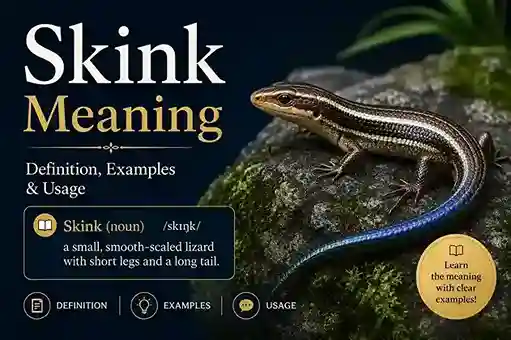
You spotted a sleek, shiny creature sliding through the leaves and froze. Was it a snake? A worm? Something else entirely? That flash of confusion is exactly why knowing the real skink meaning matters—most people misidentify these secretive reptiles or overlook the powerful symbolism they carry. This guide settles the confusion once and for all, giving you a complete, people-first look at what a skink actually is and the fascinating layers of meaning attached to it.
What Is a Skink? The Core Skink Meaning
One kind of lizard in the Scincidae family is the skink. Unlike the typical image of a lizard with long legs and a prominent neck, skinks often have elongated, cylindrical bodies, reduced limbs, and smooth, overlapping scales that give them a polished, almost snake-like appearance. This unique body plan forms the foundation of the basic skink meaning: a lizard that prioritizes sleek, ground-hugging movement over flashy display.
Biologically, skinks are reptiles. They have eyelids that move (unlike snakes), external ear openings, and the ability to autotomize—drop their tail—when a predator grabs them. That tail wiggles on the ground, buying the skink precious seconds to vanish. Right there, the skink meaning expands: survival through clever sacrifice, not brute force.
Etymology and Origin: Where the Word “Skink” Comes From
Language adds another layer to the skink meaning. The word traces back to the Latin scincus, which in turn came from the Greek skinkos. Ancient writers used it to describe a specific North African lizard. According to the Merriam-Webster dictionary, the term entered English usage in the 16th century. Early naturalists applied it broadly to smooth-scaled, burrowing lizards.
That classical root matters. For centuries, the skink meaning in texts was tied to medicine and folklore—dried skink bodies appeared in old apothecaries. Knowing the origin helps you see why the skink carries a quiet, ancient weight that newer animal symbols lack.
Skink Meaning in Herpetology: How Scientists Define This Lizard
In scientific terms, the skink meaning hinges on a distinct set of anatomical traits. Herpetologists point to the presence of osteoderms (bony plates beneath the scales), a cone-shaped head with a pointed snout, and a streamlined body built for slipping through leaf litter or loose soil. These features separate skinks from geckos, iguanas, and wall lizards.
A study published in Herpetological Conservation and Biology reinforces that skinks rely heavily on crypsis—blending into their environment—rather than speed or aggression. So the biological skink meaning reflects a master of staying hidden, a reptile that thrives by not drawing attention. When you lift a log and find one, you’re meeting an animal engineered for quiet persistence.
Physical Characteristics That Define the Skink Meaning
Shape instantly communicates the skink meaning. Most skinks display a cylindrical body, smooth cycloid scales that reflect light like polished armor, and legs so small they seem almost decorative. Some species, like the European glass lizard, have lost legs entirely yet remain true skinks.
Coloration adds another clue. Many skinks sport muted browns, bronzes, or olives. Juveniles often flash a brilliant blue tail—a decoy that directs a predator’s strike away from the head. That blue tail fades with age. Here, the visual skink meaning is layered: youthful boldness that gives way to seasoned subtlety.
- Smooth, overlapping scales (glossy look)
- Cone-shaped head with a distinct neck
- Small or reduced limbs in many species
- Tail that easily detaches and regenerates
- Movable eyelids (unlike snakes)
How Skinks Differ from Other Lizards: A Clear Comparison
Mistaking a skink for a salamander or a juvenile snake muddles the real skink meaning. This table cuts through the confusion instantly.
| Feature | Skink | Typical Lizard (e.g., Gecko) | Salamander |
|---|---|---|---|
| Skin | Dry, glossy, scaled | Dry, textured, scaled | Moist, smooth, permeable |
| Body shape | Cylindrical, elongated | Varied, often stocky | Long, moist, with visible limbs |
| Activity | Diurnal (mostly) | Often nocturnal (geckos) | Nocturnal or crepuscular |
| Tail defense | Autotomy (drops tail) | Some autotomy | Regeneration, no active drop |
| Habitat | Leaf litter, loose soil | Walls, trees, rocks | Near water, damp forest floor |
Once you lock in these differences, the skink meaning stands alone. It’s not a wet-skinned amphibian; it’s a dry, sun-loving reptile built for a hidden life.
Where Skinks Live: Habitat and Global Distribution
Habitat tells you what the skink meaning looks like in practice. Skinks inhabit every continent except Antarctica. The greatest diversity explodes across Southeast Asia, Australia, and sub-Saharan Africa. According to the IUCN Red List, over 1,700 species fill niches from desert dunes to tropical rainforests.
In North America, the common five-lined skink thrives in wooded areas with abundant fallen logs. In Australia, the Cunningham’s skink clusters on rocky outcrops in social groups. The environmental skink meaning is adaptability without drama—a creature that claims its space and makes the most of ground-level resources.
Common Types of Skinks and Their Meaning in Nature
Each species adds a specific color to the broader skink meaning.
- Blue-Tongued Skink (Tiliqua): The bright blue tongue flashes as a startling warning display. Its skink meaning emphasizes bluff, surprise, and setting boundaries.
- Five-Lined Skink (Plestiodon fasciatus): Juveniles carry that electric blue tail. The meaning here centers on growth, transformation, and the wisdom of outgrowing flashy defenses.
- Sandfish Skink (Scincus scincus): This skink “swims” through loose sand, a literal disappearing act. Its skink meaning is all about flowing with difficulty rather than fighting it head-on.
- Solomon Islands Skink (Corucia zebrata): An arboreal giant that lives in family groups, a rarity among reptiles. Here the skink meaning shifts toward cooperation, protection, and breaking the rules of solitary reptile behavior.
- Green Tree Skink (Lamprolepis smaragdina): Bright green and agile, it represents vibrant, active adaptation in the canopy.
Skink Meaning in Culture, Symbolism, and Mythology
Beyond biology, the skink meaning steeps itself in cultural and spiritual interpretation. Ancient Egyptians included skinks in amulets, believing the creature brought protection and renewal because of its ability to regenerate a lost tail. In some Pacific Island traditions, a skink crossing your path signaled that ancestors were near, watching quietly.
Indigenous Australian Dreamtime stories often treat skinks as keepers of ground-level secrets—messengers of the soil itself. The common thread: a skink never announces itself loudly. Its power works in whispers. You’re meant to notice it, pause, and reflect.
Skink Meaning as a Spirit Animal or Totem
When skink appears as a totem, the skink meaning sharpens into personal guidance. People who resonate with skink energy tend to move through life without needing the spotlight. They observe, adapt, and survive emotional upheavals by staying grounded.
Key skink totem lessons include:
- Shed what no longer serves you: Just as a skink drops its tail, you can release relationships, jobs, or beliefs that hold you back.
- Master the art of stillness: Skinks freeze to avoid detection. Sometimes the best move is no move at all.
- Trust regeneration: The tail grows back different—functional, but scarred. Healing changes you, and that’s the point.
Anyone navigating a period of invisibility or quiet transformation will find the skink’s message eerily accurate.
Skink Meaning in Dreams: What It Signals
Dreaming of a skink brings a specific skink meaning to your subconscious. A skink that scuttles away unseen often hints at something you’re avoiding—a small fear that’s grown legs. If the skink drops its tail in the dream, the interpretation shifts toward necessary sacrifice. You may need to let go of a part of your identity to move forward safely.
If the skink looks directly at you, many dream analysts link that moment to heightened intuition. The creature asks you to trust your gut about a situation you’ve been overthinking. A blue-tongued skink in a dream serves as a warning: something you’re treating as harmless isn’t—boundaries need asserting. These layered dream interpretations show why the full skink meaning extends so far past a simple field guide entry.
Skink as a Pet: What the Experience Teaches You
Caring for a pet skink rewires your understanding of the skink meaning through daily interaction. Blue-tongued skinks stand out as popular choices because they tolerate handling and display clear individual personalities. Keepers quickly learn that a skink’s trust must be earned through gentle routine—sudden movements break the bond.
The practical demands mirror the symbolic message. Skinks need warm basking spots, UVB lighting, and a secure hide. Without those, they stress and decline. Here the skink meaning comes full circle: you create a safe, warm environment, and the animal thrives in response. The lesson lands hard—you too need environments that let you shed old skin without fear.
Conservation Status: Why Protecting Skinks Matters
Ignoring skinks erases more than a few lizards. The skink meaning on a planetary scale ties directly to ecosystem health. Skinks control insect populations and aerate soil through their burrowing habits. Yet habitat loss, invasive species, and climate change threaten many species. The IUCN lists species like the Round Island skink as vulnerable, with dedicated recovery programs racing to save them.
National Geographic highlights that ground-dwelling skinks serve as indicator species—their presence signals a functioning, balanced micro-ecosystem. When skinks vanish, the soil and insect cycles break. Protecting them keeps the literal ground beneath us alive. That’s the ultimate, no-nonsense skink meaning we can’t afford to ignore.
Frequently Asked Questions About Skink Meaning
What is the spiritual meaning of a skink?
The spiritual meaning of a skink revolves around quiet regeneration, shadow work, and moving through difficulty without confrontation. It signals a time to release attachments and trust your ability to heal.
What does it mean when you see a skink?
Seeing a skink often means you need to pay attention to something hiding in plain sight—an overlooked solution or an ignored emotion. The encounter pushes you to pause, watch, and act only when necessary.
What is the difference between a skink and a salamander?
A skink is a dry-scaled reptile with claws and ear openings, while a salamander is a moist-skinned amphibian without claws. Skinks bask in the sun; salamanders stay near water.
What does skink mean in dreams?
In dreams, a skink represents avoidance, sacrifice, or subtle intuition depending on the action. A skink fleeing warns of ignoring a problem; a skink dropping its tail suggests a beneficial letting-go.
Is a skink a good luck symbol?
Many cultures consider the skink a symbol of renewal and protection, not conventional luck. Its presence marks a period of quiet growth rather than sudden fortune.
What does the word skink mean in origin?
The word “skink” derives from the Greek skinkos and Latin scincus, both referring to a smooth-scaled lizard. Historically, it described a specific North African reptile used in ancient remedies.
The Deeper Skink Meaning You Can Take With You
Skinks don’t roar, don’t charge, don’t demand attention. They teach a different kind of strength. The next time you uncover one beneath a rotting log or spot it basking on a stone, remember the full skink meaning isn’t just about a lizard—it’s about resilience through stillness, wisdom through release, and the quiet power of staying grounded when everything around you shifts. Take that lesson into your own world. Watch. Adapt. And if something grabs hold of you, be ready to leave your tail behind and grow something new.