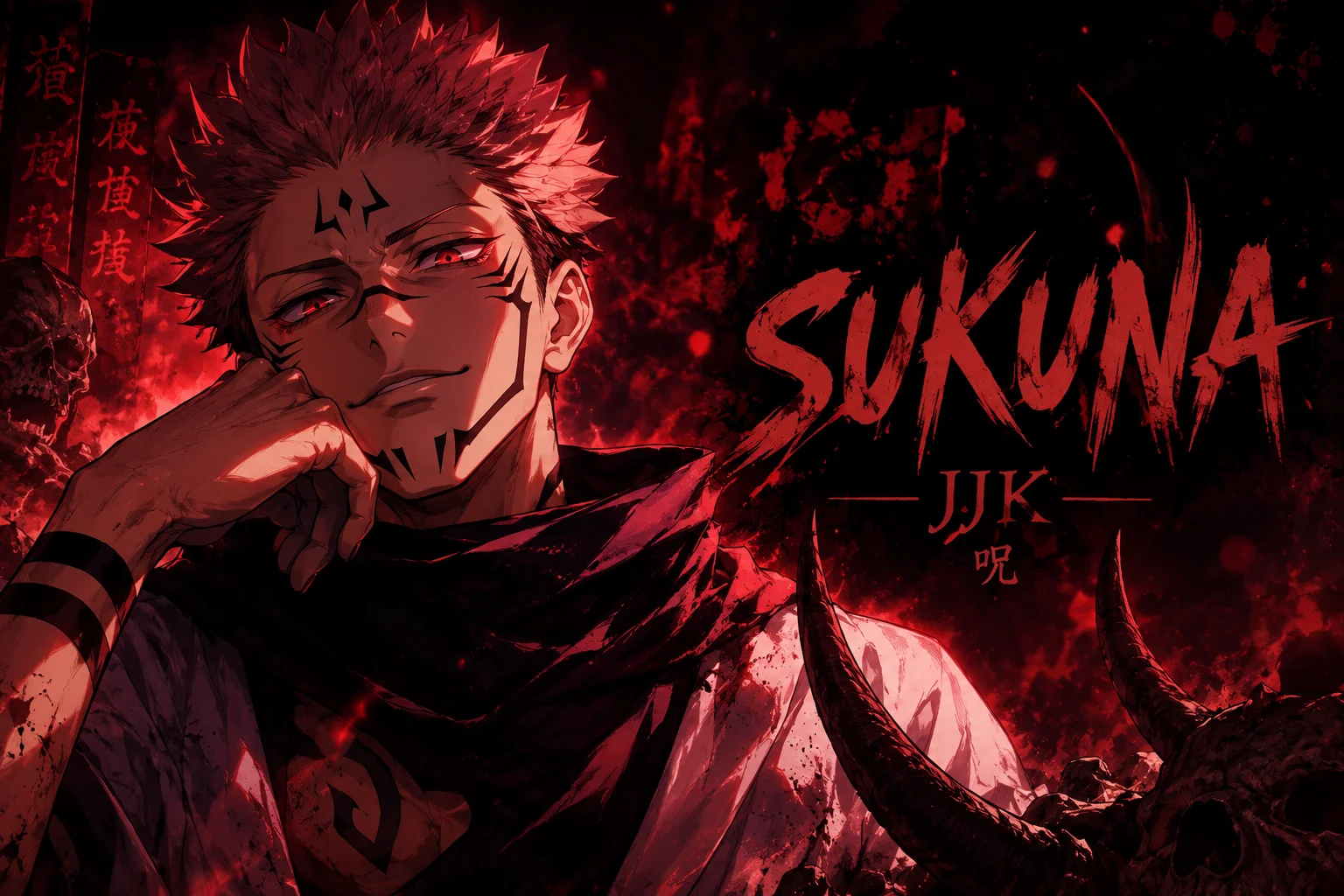
The King of Curses — What Makes Sukuna Different
There are strong villains, and then there is Sukuna.
In a series filled with terrifying curses and legendary sorcerers, Ryomen Sukuna stands apart. He is not just powerful — he is the measuring stick every other threat in Jujutsu Kaisen is compared against. Gege Akutami built the entire world of JJK around one unavoidable truth: nothing walking the earth comes close to what Sukuna represents.
Whether you just started the anime or you have been tracking every manga chapter, this guide covers everything worth knowing — his origin, his age, his true form, and the techniques that make him genuinely unstoppable.
Who Exactly Is Sukuna JJK?
Sukuna is the most powerful cursed spirit in the history of Jujutsu Kaisen, and he earned that title a thousand years before the story even begins. During the Heian Era — a period regarded as the golden age of sorcery in the JJK universe — he walked the earth as a living human being with cursed energy so vast that even the greatest sorcerers of that age could not bring him down.
When those sorcerers finally realized they could not kill him, they did the next best thing: they dismembered his body into twenty fingers and sealed each one as a cursed object. The idea was simple. Keep the pieces scattered. Keep the world safe.
That plan worked — until Yuji Itadori swallowed one of those fingers on a dare.
From that moment forward, Sukuna shares Yuji’s body. He watches. He waits. And occasionally, he reminds everyone exactly why they should be afraid.
How Old Is Sukuna?
Sukuna is well over 1,000 years old. His origins trace back to Japan’s Heian period, which lasted roughly from 794 to 1185 CE. That alone makes him older than most institutions, kingdoms, and historical records that still exist today.
What makes this more unsettling is that those centuries were not exactly restful. He existed as a collection of cursed fingers — conscious enough to corrupt anyone who came near them, patient enough to wait for the right vessel to come along.
When Yuji consumes his finger, Sukuna does not wake up groggy or confused. He picks up right where he left off. A thousand years of stillness did not dull him. If anything, it sharpened his appetite.
Sukuna’s True Form — What He Actually Looks Like
Most anime-only fans picture Sukuna through Yuji’s body — the face tattoos, the extra set of eyes, the mouth hidden on the palm. That is his borrowed appearance, a fraction of what he really is.
His true form is something else entirely.
Standing over eight feet tall, the real Sukuna has four arms, two faces arranged vertically on a single head, and complex markings covering his entire body. He does not look like a villain from a story. He looks like something ancient texts would warn you about — and in the JJK universe, they literally do.
This design is not accidental. Gege Akutami drew directly from Japanese mythology when shaping Sukuna’s appearance. The real Ryomen Sukuna appears in the Nihon Shoki and other historical documents as a two-faced, four-armed figure said to terrorize the Hida region of ancient Japan. Some villages worshipped him. Others simply feared him too much to resist.
The manga faithfully reflects that mythology. When his true form emerges, it does not feel like a transformation. It feels like an unveiling — something that was always there, just temporarily hidden.
Sukuna’s Cursed Techniques and Abilities
Sukuna’s power is not random destruction. Every technique he uses reflects genuine mastery over cursed energy that took centuries to develop.
Cleave — His most adaptive attack. Cleave reads the defensive output of a target and adjusts its cutting force to match exactly. Regardless of how tough the opponent is, Cleave finds the threshold and exceeds it.
Dismantle — A companion to Cleave, this technique targets enemies without a defined physical structure. Where Cleave handles flesh and material, Dismantle handles energy, curses, and anything that refuses to hold a solid shape.
Malevolent Shrine — Sukuna’s Domain Expansion, and one of the most destructive in the entire series. Unlike most domains, which trap opponents inside an enclosed space, Malevolent Shrine extends outward. Everything within its radius — allies, enemies, buildings, terrain — gets continuously slashed without pause. It is expansion without walls, which means there is no safe boundary to stand behind.
Reverse Cursed Technique — Most sorcerers can only apply cursed energy to harm. Sukuna understands how to invert that flow to generate healing energy, allowing him to repair severe injuries in real time. Lost a limb mid-fight? He simply regrows it.
Together, these abilities make Sukuna more than just a powerful fighter. He is a complete system — offense, defense, and recovery all wrapped into one ancient, unbothered entity.
Sukuna’s Biggest Battles in the Manga
The true scale of Sukuna’s threat becomes clear through the opponents he faces.
His battle against Satoru Gojo — the only other character in JJK considered on his level — shook the entire community when it finally arrived. Gojo spent years being treated as the unbeatable ceiling of human sorcery. Their clash answered the question every fan had been asking since the series started.
His acquisition of Megumi Fushiguro as a vessel opened a new chapter entirely. By taking control of someone with the Ten Shadows Technique, Sukuna didn’t just gain a new body — he gained an entirely different ability set to layer on top of his own.
Later arcs bring Yuta Okkotsu and Maki Zenin into direct conflict with him. Both are exceptional fighters. The fact that even they struggle underlines just how enormous the gap is between Sukuna and everyone else.
Sukuna’s Role Across the JJK Manga Arcs
Sukuna’s presence evolves significantly as the manga progresses.
Early on, he operates in the background — a dark, sardonic presence inside Yuji who occasionally surfaces to save them both when things go badly wrong. He feels like a dangerous ace card with unclear conditions.
The Shibuya Incident changes everything. He breaks free under specific circumstances and does enormous damage in a short window of time. What the city looks like afterward gives readers the clearest picture yet of what unchecked Sukuna actually means.
By the Shinjuku Showdown Arc, he becomes the central antagonist in full. No more shadows. No more borrowed moments. Every chapter becomes about whether the modern generation of sorcerers can find any answer to someone who has had a thousand years to become exactly what he is.
Why So Many Fans Choose a Sukuna PFP
Profile pictures reveal something about the person using them, and Sukuna communicates a specific message — you appreciate a villain who earns it.
His visual design works exceptionally well at small sizes. The facial tattoos, the extra eyes, and the iconic hand mouth all read clearly even as a thumbnail. High-contrast manga panels tend to work best, especially close-up shots where his expression carries the full weight of his indifference toward everyone around him.
Beyond aesthetics, using Sukuna as a profile image signals taste. It says you follow Jujutsu Kaisen closely enough to move past the main characters and recognize what the story is really built around.
Quick Reference — Sukuna at a Glance
| Detail | Information |
|---|---|
| Full Name | Ryomen Sukuna |
| Title | King of Curses |
| Age | Over 1,000 years |
| Origin Era | Heian Period |
| Cursed Remains | 20 severed fingers |
| Signature Techniques | Cleave, Dismantle |
| Domain Expansion | Malevolent Shrine |
| Current Vessel | Yuji Itadori / Megumi Fushiguro |
| Publisher | Shueisha — Weekly Shonen Jump |
| Creator | Gege Akutami |
The Mythology Behind the Character
Gege Akutami did not create Sukuna entirely from imagination. The character pulls from a real historical figure documented in ancient Japanese texts.
The Nihon Shoki, one of Japan’s oldest chronicles, describes a being called Ryomen Sukuna — literally “two-faced Sukuna” — as a powerful figure with multiple limbs who defied imperial control in the Hida region. Some local traditions in that area still carry his name in shrines and place names.
Akutami took that foundation and built something modern out of it. The physical description maps almost perfectly onto the true form shown in the manga. The attitude — contemptuous of authority, impossible to subdue through normal means — fits just as cleanly.
That grounding in actual folklore is part of what makes Sukuna feel weightier than a typical shonen antagonist. He carries real cultural history into every scene.
Frequently Asked Questions
How old is Sukuna in JJK?
Over 1,000 years. He originates from the Heian Era, which historians date between the late 8th and late 12th centuries. He spent most of that time sealed inside twenty cursed fingers before Yuji accidentally reactivated him.
What does Sukuna’s true form look like?
His original body stands over eight feet tall with four arms and two faces stacked on a single head, covered in markings that reflect his cursed energy. It looks nothing like the human vessels he currently occupies.
Where can I read the JJK manga legally?
Both the Viz Media website and the Manga Plus app by Shueisha offer chapters legally, with new releases available simultaneously with the Japanese publication.
Why is Sukuna considered unbeatable?
His techniques adapt to whatever defense an opponent uses, his Domain Expansion damages everything in an open radius with no safe zone, and his mastery of Reverse Cursed Technique means conventional damage barely slows him down.
What is the best type of Sukuna pfp?
Close-up manga panels showing his facial markings or his four-armed true form tend to display best at profile picture dimensions. High-contrast black-and-white panels from Akutami’s art style hold detail well even at small sizes.
Is the JJK manga still worth reading?
Absolutely. The final arcs represent some of the strongest action art Akutami has produced, and the narrative stakes have never been higher. Sales figures and readership numbers remain among the top in Weekly Shonen Jump.